

When School Stops, Learning Changes Shape
Simple, joyful holiday activities that support real learning at home

Looking for a few ideas to help occupy the kids over the school holiday period?
Straight up, I need to say this: we never called school breaks ‘holidays’.
Learning happens every day. Just because the school down the road shuts its door for a few weeks doesn’t mean children stop learning. It simple means the responsibility for learning shifts back to parents. Honestly, I loved that part. I loved spending time with my children all year round and enjoying the many different activities that naturally fitted into our days.
So this list of “school holiday activities” is really just a collection of things we enjoyed doing together all year long!
Reading: make the library the heart of your homeschool
If you’re not already a regular at your local library, now is the perfect time to start.
Don’t make visiting the library a stop on the way to do the weekly shopping: treat it as a highlight of your week, a bit like a trip to that special playground the kids love.
Start by creating personalised library bags using fabric paint and material. My youngest opted to recycle a T-shirt he’d outgrown, one with a spectacular dragon printed on the front. Mine was made from an old pair jeans. We had fun recycling material from old clothes. My son created his using a much loved t-shirt he’d outgrown.
Do you know you can borrow more than books from your local library? Have a chat with the librarian about the different types of items they have available in their lending collections. Getting to know the librarian can be a real boon for homeschooling families: they are usually happy to make recommendations and help find just the right resources to match your learning plans.
I remember sitting and reading books as a five-year-old at our local library. Those weekly trips were a special, treasured time for me.
Something our Aussie libraries excel at is hosting a range of free or low-cost school holiday programs for all ages. Put your name on their email list for notifications about upcoming events and activities, and remember to book early, as they’re very popular.
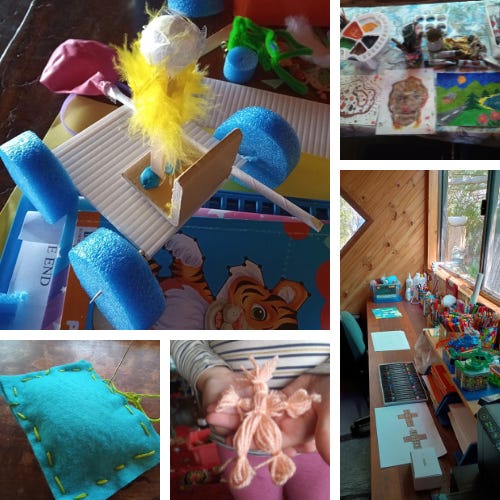
Drawing and art: use what you have
Our house was never short of drawing materials. Inspiration often came from library books on art techniques and styles, or from visits to different art galleries.
When homeschooling my kids I’d usually borrow at least one art or craft book from the library, but the internet makes it so easy to find inspiration when the grandkids visit.
My long desk is a favourite spot for them to settle, and I make sure everything they need is within easy reach:
Lead pencils of different grades, erasers and rulers
Charcoal, chalk, crayons, oil pastels
Textas, coloured pencils, watercolour pencils
acrylic, fabric and watercolour paints
Ink or food colouring.
But drawing is never confined to the desk or dining room table. The grandkids and I like to draw or paint on anything and everything:
Pavement, walls, windows
Different types of paper and cardboard
Wood, fabric, crockery, and material.
I usually waited until stationery, art and materials went on sale, often discounted up to 50% off, and tried to buy quality whenever I could. We also made good use of recycled paper and card from boxes. Our main recurring expense was sticky (Scotch) tape, paints and glue.
If your child isn’t ready for self-directed creativity, make a few simple art activity kits or boxes to spark creativity. A quick online search for “children’s art ideas” or “drawing activities” can provide endless inspiration.
Sewing and handcrafts: learning through making
If you’re even a little crafty, sewing projects are a wonderful way to engage children. Consider putting together small, age- or skill-appropriate ‘sewing kits’ for your children. Include everything they’ll need, along with simple instructions.
Some of the projects you might like to tackle together could include:
Simple felt toys for younger children,
Practical items like aprons, scrunchies,
something fun like these juggling chooks!
The Art of Home has a great collection of easy projects, and Threads Monthly have compiled a handy list of seven teacher-approved things for children to sew.
Download or create basic patterns. I’m currently co-designing a plushie with my ten-year-old grandson. He knows it won’t look something you’d buy from a shop, and he’s happy with that because, as he said, he can “customise it”.
Most children enjoy making simple and easy things, and sewing quietly teaches maths, design, problem-solving, and patience. Don’t worry if you don’t have a sewing machine: I learned to sew as a child using nothing more than a needle, thread and a scrap of fabric. If you need help (and I frequently do!), it’s easy to find instructions and tips online on how to teach your child to sew.
Dress-ups, puppets, and performance play
A dress-up box is the cornerstone of imaginative play. Children don’t elaborate shop-bought costumes. A few scarves, hats, capes, and textured fabrics are more than enough. Let their imagination and creativity flourish:
Cardboard tubes become swords or wands
Boxes turn into trains, cars, or shops
Tables draped with sheets become caves
A few years ago I found it easy to turn furry fabric and some elastic into animal ears and tails. The grandkids would play with these over and again.
Making masks is another wonderful art activity. It often starts simply with paper plates when children are young and evolves into more complex creations using a variety of different materials as their skills mature.
Puppet making follows a similar path: felt finger puppets with drawn faces give way to decorated sock puppets, simple shadow puppets, and eventually marionettes. All are props for the rich imaginative play and also support storytelling, creativity, and emotional expression.
Playing Shop: real-life maths and social skills
Until our youngest was six or seven, playing shop was a favourite activity that regularly turned our living space into a mini-mall
Our living room regularly transformed into:
A supermarket
A bank
A post office
A hairdresser
A fashion boutique (for dolls, of course).
Props came from a large “junk box” of recycled items. You’ll need plenty of sticky or masking tape to shape cardboard boxes into counters and shelves. One year we even designed our own Australian paper money. When I did this activity with the grandkids, they asked if they could design their own credit cards — so we did!
For older children, this play can transform into real entrepreneurial projects, such as making and selling handmade items at your local craft market.
Origami and paper crafts
Our tray of origami paper with its instruction book was always popular. When we ran out of shiny coloured paper, I demonstrated how to trim A4 paper into squares.
We also had fun doing different paper crafts: lovely fluffy flowers using tissues and cotton thread, paper boats that actually floated, and fashions for paper dolls.
With the grandkids I find it easy to do a search for “paper craft ideas” online, print instructions, and store them with the materials. The children browse my shelves looking for something new to try, just as my own kids did years ago.
Playdough, clay, and kitchen creations
Always have playdough available, either homemade or store-bought. Nowadays I like to have the ingredients for making slime on hand too, as it’s very popular, especially with my younger grandkids.
Older children enjoy creating models with air drying or commercial clays they can later paint.
All children (and most adults) love the oozy squelchiness of kneading and shaping clay into animal shapes or small pots. If you have access to a potter’s wheel, try throwing a pot or three!
In the kitchen, experiment making bread, plaiting loaves or making fruit buns. Have a go at making gingerbread men and houses from scratch. Baking is a great source of fun and interest for children, especially as they get to eat what they make!
Marble runs and other engineering feats!
This activity never goes out of fashion.
Save cardboard tubes for a few weeks, add marbles (or table tennis balls for younger children) and bring out the tape. Start simply, then let the kids take over. I’ve seen marble runs wrap around entire rooms, from ceiling to floor.
Our junk box was the focal point of our homeschool supplies corner for many years. By the time the grandkids came along I knew to keep several rolls of Scotch and masking tape on hand — they went through it quickly! I kept our junk box stocked with a plentiful supply of different shaped containers and objects.
It became a rich source for hands-on physics, problem-solving, and design thinking, all using materials destined for the recycling bin.
Knitting and crochet: slow, patient learning
Almost everyone ends up knitting something, even it is only a square for a blanket for Teddy or a half-finished scarf for Dad.
My knitting skills are basic, but I’ve enjoyed exploring finger knitting, hand knitting, French knitting, and knitting on a circular loom with the kids and grandkids. I still remember how proud I felt as a young child completing my first (and only) granny blanket from wool left over from my mum’s knitting projects.
Everyday life is the curriculum
Life at our house was never dull. The children and I were always doing something — cooking, gardening, helping dad with his DIY projects, playing or creating.
We were inspired by what we saw others doing: friends, or while out and about, on television or in books. Our “have a go” attitude helped the children develop confidence, creativity, and strong problem-solving skills, along with the ability to turn junk into useful and treasured items.
Rethinking the word “holidays”
In our house, holidays meant travelling, visiting relatives, and sightseeing. School terms didn’t feature in our lives. We didn’t see the need to have a holiday from homeschooling because homeschooling was an integral aspect of our everyday life. Every day of the year.
And at this time of year, and frequently during school term breaks, learning at home didn’t switch off, it just changed shape.
If you found this article useful let me know in the comments, as well as what other games and activities you already use to help teach your child maths skills.
I’m dropping Notes most days and would love to connect with you that way. Don’t forget we can keep the conversation going on any of my posts by adding a comment on any of them too.
Subscribe to my newsletter and you’ll never miss an update: every new post is sent directly to your email inbox. Free or paid, you’ll still get at least one email each week. My regular posts won’t ever be behind a paywall.
Whatever your approach, your lifestyle or education philosophy, I’m here to support you. Take what you need, leave the rest. I want you to lean on my experience because I’ve leant on others — we are in this together, growing and learning from each other!
That’s all for now! Until next time, Beverley

Looking for information on how to start homeschooling and where to find Australian curriculum suppliers and providers? Download my FREE comprehensive guide today!
Here’s what you can expect from my regular Substack newsletter:
Themed Weekly Focus: Each week has a clear focus, helping you strengthen key areas of your homeschool without feeling scattered.
Encouragement for the Hard Days: Because we all have them, and sometimes a fresh perspective is all we need.
Practical Tools & Ideas: Information about homeschool resources, hands-on activities, exclusive templates, and ways to simplify planning.
Real Talk About Homeschooling: Honest discussions about the challenges and triumphs from someone who has been there and done that, and whose kids are now homeschooling theirs!
To my paid subscribers, who receive my exclusive Monthly Free Resources Round Up Newsletter, homeschool templates, checklists, unit studies, infographics, e-books and more, I can’t thank you enough for supporting my work!

Fully agree with your perspective on holiday “breaks,” and love the accessibility of your creative ideas. We implement many of these already, but you’ve helped spark a few additions to our rhythms!
Some wonderful ideas here. Thank you so much. I am pulling out the dressing up box now and making sure we make very good use of our local libraries over the festive period! 🙏