

When Learning Feels Like a Battle: Rethinking Motivation in Homeschooling
How shifting our focus from control to connection can transform the way our children learn at home

Some days it feels like I am obsessively worrying how to motivate the kids to learn. I spend countless hours searching for suitable resources, work long hours to be able to pay for them, and then spend more hours learning how to use them. I present our children with what we think are incredibly interesting and appealing materials and watch them either:
Turn up their noses and ignore them,
Finger through them disinterestedly,
Suddenly remember they didn’t eat enough breakfast,
Start a fight with their siblings, or
Wilt visibly and groan “my tummy hurts...”
If I’m lucky they might begin enthusiastically and do a few pages before their eyes slowly glaze over… Sounds familiar?
At one time or another most of us have succumbed to bribing our little learners with ‘smiley face’ stickers, gold stars, small toys, food, special outings, even money. We try anything and everything we can to get them to learn what we want them to…
I thought about calling this post “What to Do When Children Don’t Want to Learn” and present you with a collection of tips and ideas to motivate children, but that’s not my style. If you’re looking for a quick-fix list of suggestions check the internet: I found dozens of pages – all of them useful – but most of them geared toward motivating the schooled student. Homeschool isn’t school. This means we have a different set of motivation problems. We need a different approach.
Whenever I begin to brainstorm solutions, I usually begin by seeking to understand the needs present and to define the problem.
What do we actually mean when we complain about our children’s lack of motivation to learn at home?
Like me, you’ve probably found yourself standing over children who resist all of your attempts to focus their minds on the task or activity, or to finish an assignment, a page in their workbooks, or “just one more sum”.
At age four, my youngest refused to colour a picture and when threatened rebelled in a by colouring everything in picture purple. I wanted him to finish the task and he did, under duress. Guess who learned the most important lesson to be had on that day! In that instance I was forced to look at why I wanted him to complete the activity. I couldn’t think of any reason related to his educational need. It was actually a ‘time-filler’ for my benefit, so that I could work with his older sibling. His stubbornness and refusal to do what I wanted served to remind me that his time was just as important as mine, and wasting it by offering meaningless activities was disrespectful.
Isn’t it up to us to know why we’re asking our children to learn what we put in front of them, and to be able to explain our reasons, what it is that motivates our desire for them to learn?
If we’re confused about why we are teaching our children at home, they will detect it and become confused learners. Our children need to know that we know what we’re doing, and that we are leading by example. This doesn’t mean to say we can’t mess up and make mistakes: Children are incredibly forgiving if we acknowledge that we are learners too.
When a family decides to homeschool, there is a shift in the focus of family life, as parents become more involved in their children’s day to day lives, interests, curiosities, and activities. What begins as an adventure in alternative education becomes a deeper and more meaningful adventure in parenting.
It’s worth remembering that we’re not schoolteachers: we’re parents. Our children know the difference and they want us to know it too. They don’t want us to behave like schoolteachers and they don’t respond that well to the methods teachers use in schools. It is a simple and obvious idea but one that takes most of us some time to embrace and accept.
Our kids need us to be authentic in our motives and intentions, to provide them with opportunities to learn in ways that are personally relevant and meaningful to them, in context with their lives and that make sense in this moment.
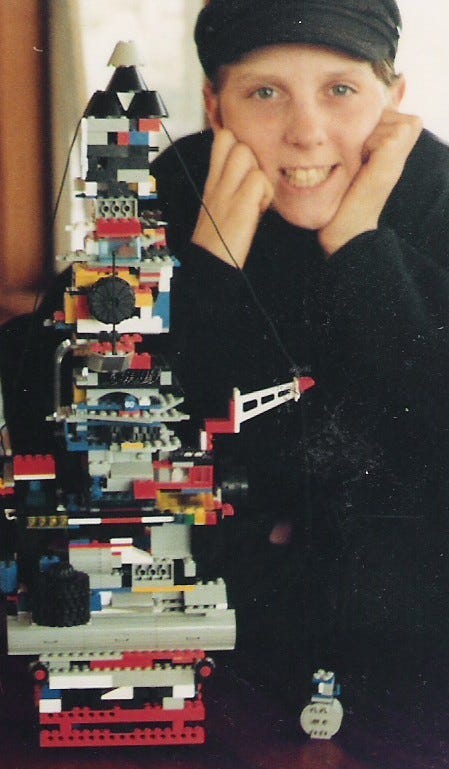

A few things I’ve been thinking about this week…
Observing my grandkids, watching how my kids parent them, has me biting my tongue sometimes. I was an over-protective, paranoid parent — a little too much at times, and I need to let my kids make the same mistakes I did, so they too can learn from them. All in all though, I’m proud of the way they’re raising their kids. It gives me a lot of hope for the future. I wrote this a few weeks back:
I can't let go of 'rescuing' my children...
Unlearning Rescue Mode: Trusting My Children to Grow

As soon as kids learn how to talk they’re asking questions, usually way too many! We bemoan that fact, make jokes about it. Sadly however, especially if they’ve spent any time in school, by the time they’re 8 or 10 years old they no longer pepper us with questions... I love going places in the car with my grandkids, especially when the questions start rolling. One leads to another, and then another. And I have to say, boy am I glad mobile phones were invented and the internet gave us access to the world wide web and answers at our fingertips!
Why, how, when... get those questions happening!
Make questioning a routine part of your homeschooling day

Decades ago, in our early homeschooling days I came across this a newsletter, probably Growing Without Schooling, and kept a copy. It inspired me to think beyond how traditional way education is doled out in school and helped set us firmly on the natural learning, or unschooling path. I hope you enjoy it as much as we did all those years ago. The original author is unknown.
"I'm not very good in school..."
a tale about natural learning, the essence of unschooling or life learning

Well, that’s enough for this week!
I’m dropping Notes most days and would love to connect with you that way — you can add a comment or heart. Don’t forget we can keep the conversation going on any of my posts by adding a comment there too.
Subscribe and you’ll never miss an update: every new post is sent directly to your email inbox. Free or paid, you’ll still get at least one email each week. My regular posts won’t ever be behind a paywall.
Whatever your approach, your lifestyle or education philosophy, I’m here to support you. Take what you need, leave the rest. I want you to lean on my experience because I’ve leant on others — we are in this together, growing and learning from each other!
That’s all for now! Until next time, Beverley
I was a tutor for 25 years for high school students, and I am in awe of parents who homeschool. Thank you for creating resources that support them. I really struggled in the traditional school system, but I'm not sure if homeschooling was even a thing back in the '70s. And my parents certainly wouldn't have taken the time to do it... But I wonder sometimes if I might have had an easier time of it if I could have just learned at home.
I think I might have one like that, too! I hope I will manage to foster resilience as much as the creativity!