

Using Your Community: A Practical and Inspiring Guide for Home Educators
Discover how your local community can become a vibrant classroom full of real-life learning opportunities.

Learning Beyond the Kitchen Table
One of the greatest gifts of home education is time: to explore, to connect, and to learn in ways that go far beyond books and worksheets. Our communities are rich learning environments, filled with people, places, and experiences that help our children understand the world and their place in it.
Whether you live in a small town or a big city, opportunities are everywhere. This guide is here to help you notice them, use them, and weave them naturally into your home learning life.
Home education really comes into its own when you step outside your front door. Community activities, local events, and volunteer opportunities are ready-made learning experiences that teach empathy, social skills, and practical knowledge.
Many home educating families recognise the educational and developmental value of community service. When children get involved in local project, they don’t just learn about the community, they become part of it, adding depth to their understanding of diversity and belonging.
Your local newspaper or newsletter plus online community groups are a goldmine for discovering upcoming events and regular events.
Community Activism
Getting involved in local community projects, environmental causes, charities, or advocacy gives children a sense of belonging and ownership.
You might visit the local council chambers, sit in on a meeting, or simply discuss local issues together. Children appreciate understanding how decisions are made, and being involved in community based actions like organising or signing petitions, lobbying for causes that interest them, feeling like their actions might make a difference. These experiences can inspire them to become thoughtful, active citizens.
Don’t be shy about introducing yourselves as a homeschooling family: most clubs and community groups are very welcoming once they understand your children will be fully supervised.
Senior Citizens and Residential Aged Care Homes may welcome and appreciate regular visits from groups of homeschooling children to play or perform.
Encouraging your children to connect with people of different ages, backgrounds, and interests helps them develop the confidence to interact with all kinds of people, a vital life skill that’s hard to teach from a textbook.

The World of Media
We live in a media-saturated world, and learning how to navigate it is a skill that will serve our children for life. And we’re not just talking about online media: books, newspapers, magazines, advertising, TV shows, film, radio, podcasts, even performances and exhibitions fall under the description of media. All are designed to impart information.
Watching, reading, and listening together as a family, and then talking about what you’ve seen, builds awareness, critical thinking, and understanding.
You don’t have to run a “media studies” course; simply paying attention to how messages are presented and what viewpoints are included (or excluded) is a wonderful education in itself.
Take advantage of some of brilliant online resources, such as eSafetykids, to help them how to navigate and use the internet safely.
Creating Your Own Media
Children love to make things, so why not encourage them to create their own news? Start a family newspaper, record a short podcast, or make a community blog. These activities turn them into active participants rather than passive consumers of information.
If your child is interested in journalism or broadcasting, ask your local newspaper or radio station about tours. Many are happy to host families or small groups.
And don’t underestimate the thrill of seeing their name in print! Writing letters to the editor or short articles for a local newsletter gives children a sense of voice and contribution. If you’re lucky enough to have a local or state-wide homeschooling newsletter be sure to encourage your kids to contribute: the editors absolutely love that!
Learning Through Media Discussions
Use current affairs programmes or documentaries as springboards for conversation. Here in Australia we have the very popular BTN (Behind the News), produced by the national broadcaster. Aimed at 10-13 year old kids, it unpacks and explains news and current affairs to young people in a dynamic and creative way
Talk about what makes some news sources more reliable than others. With younger children, discuss why some topics need to be censored and what makes a story “quality” media.
Tap into free learning resources such as ABC Educations Guide to Media Literacy, or the National Library of Australia’s Media and Information Literacy modules.
This kind of learning develops not only comprehension and reasoning but also media literacy, a key and very necessary life skill they will definitely need in adult life.
Educational Venues: Learning Everywhere
In home education, almost anywhere can be an educational venue. The trick is to start seeing everyday experiences as learning opportunities.
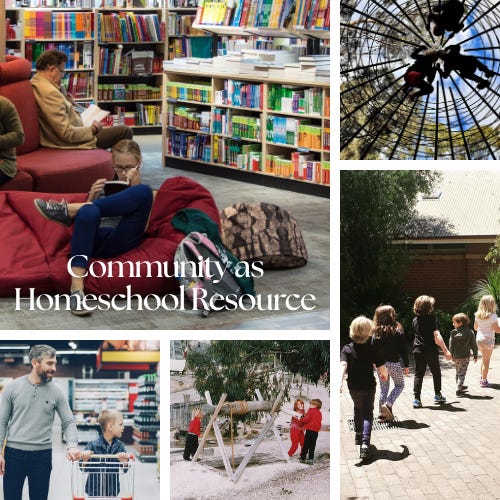
When you go shopping, for example, you can weave in lessons on maths, budgeting, and even social communication. The local bank, post office, or polling booth are all mini-classrooms waiting to be explored. Take your children along when you vote, visit a council meeting, or chat with a local business owner about their work.
Children are naturally curious. If they ask how something works, follow their lead. Visit a locksmith, a baker, a potter, or a mechanic. Most tradespeople are delighted to explain what they do if approached politely.
Allow extra time to accommodate learning opportunities. They can crop up when you’re shopping for groceries. Instead of seeing these everyday tasks as chores to be done as quickly as possible, make time for the children to be involved, acknowledging that their inexperience and lack of expertise requires your patience and mentoring. These ‘life lessons’ are far more efficient and effective than doing worksheets!
Nature as a Classroom
The natural world is one of the richest learning environments available. Whether it’s your backyard, a local reserve, or a national park, there’s endless scope for discovery.
Australia’s landscapes, from deserts to rainforests to snowy peaks, offer a living geography and science lesson. Simply exploring these environments together can spark lifelong curiosity about ecology, geology, and conservation.
And it’s hard to ignore the built environment wherever we venture outside. As you drive through suburbs and towns you can chat about how things change over time: building and gardening styles, town planning and layouts, statues and sculptures.
Get in the habit of noticing and talking about whatever environment in which you find yourself. Curiosity is contagious!
Libraries, Community Gateways to Knowledge
With their commitment to intellectual freedom, equitable access to information, libraries are a home educator’s best friend. They’re free, full of treasure, and staffed by people who love to help others learn.
Community libraries offer diverse activities for all ages, including children’s story times and holiday programs, and adult events like book clubs, craft groups, and digital skills workshops. They also host special events like author talks, movie afternoons, and family history help sessions, with many programs being free or low-cost.
Show your children how to use library catalogues, explore the difference between fiction and nonfiction, and discover how books are organised. Encourage them to interact with librarians, ask for help, and treat the library as their own learning space.
Regular visits also teach respect, responsibility, and a love of focus: skills that serve them well in every part of life.
Museums, Galleries, and Cultural Centres
Museums and galleries are the ultimate hands-on learning spaces. They bring history, science, and art to life in ways no textbook can. Some are obvious but most are hidden away, quiet unassuming spaces. The best place to find them all is your town’s Visitors Information Centre.
Encourage your children to read exhibit signs aloud, ask questions, and engage staff in conversation. You’ll be amazed how much information and inspiration they’ll gain simply by being curious.
Make time to stop and look at old shops, schools, prisons, cemeteries, mines, factories, and farms and equipment. Anything can be a starting point for conversations, which can often lead to finding books or information later that answer questions.
Monuments and memorials also connect us to past events and people, often in an emotional way.
Take advantage of any open days, local shows or festivals: these are usually advertised well in advance. Think about military museums and displays, vintage car processions, pageants, historic houses or open gardens… There is usually something happening somewhere every week of the year!
Art galleries are wonderful places for quiet reflection and creative inspiration. Discuss what you see: the colours, the shapes, the emotions. Encourage your children to express what the artwork makes them think or feel. Later, let them create something inspired by what they’ve seen. If you’ve got time, take a sketchpad and pencils, get yourself comfortable: lots of artists do!
Art appreciation and literacy is as important as creating art. It isn’t about having the right answers or knowing all the facts about artists or styles: it’s about developing observation, imagination, and empathy, and learning to develop an understanding of what the artist may be trying to convey in their artworks.
Science often have outreach programs that visit community spaces. Search out observatories or planetariums in your region to explore the solar system and stars. Aquariums, zoos, nature parks and conservation reserves are always favourites with most kids, and homeschoolers are able to pick times when they’re less busy!
From local history museums to science centres, observatories, and Aboriginal and Torres Strait Islander cultural centres, and botanic gardens, each offers something unique. These visits build cultural awareness and connect children to both their heritage and the wider world.
Local Businesses: Doorways to Learning in the World
Local businesses can be some of your best educational partners. Visiting a bakery, mechanic, or hairdressers gives children real-world insights into how things work.
Have a chat to see if they’re open to the idea of hosting an organised 30 minute or so excursion for a small group of homeschooling kids. Offer some information about home education if they’re not already familiar with it.
Inquire about group tours of factories and other places of employment. Some may already offer school group tours and have a protocol in place to guide your planning.
Practical Learning
Hardware and gardening stores are brilliant for hands-on learning: ask for advice, attend workshops, and let your kids get their hands dirty. Music shops, computer stores, and game clubs are also great for exploring hobbies that may grow into lifelong passions or careers.
Seek out physical fitness venues that offer healthy activities for children, such as indoor playgrounds, urban or tree climbing gyms, skating rinks, climbing gyms, gymnastics, circus skills, indoor adventure parks such as Bounce, etc. Sports complexes often offer school rates or discounts to home educating groups and may be able to offer activities during the school week when they are less busy.
Don’t forget vet clinics, animal hospitals, pet stores and animal shelters. Most kids are fascinated by and love animals. The Royal Society for the Prevention of Cruelty to Animals and similar organisations are there to educate and inform the community about animal welfare and usually offer junior memberships and programs.
Future Focused
Get to know and support local business people, especially if you have adolescent children. Be an active, positive and constructive member of your local community online forum, and if you’re inclined and have the time consider volunteering for a service organisation, such as Lions Club, Country Women’s Association, or your town’s Progress Association.
This builds a network of acquaintances that may prove invaluable when the time comes to source work experience or casual and part time jobs for your children.
Community Groups and Volunteering
Community groups are the heart of local life. They’re where children can see cooperation, service, and creativity in action.
Volunteering helps children develop empathy, responsibility, and a sense of purpose. These acts of service often lead to wonderful friendships and a deeper understanding of what makes communities thrive.
Special Interest Clubs
There’s a club for almost everything: robotics, gardening, astronomy, history, writing, animal care, lapidary, drama, choir, and more. These groups are full of passionate, experienced people who love to share their knowledge. Joining one can open doors to mentorship, skill-building, and real-life connection.
Before turning up to a group or venue, call ahead and establish how the group operates and how it feels about children or families taking part. Emphasise that your children will be supervised by you at all times, and offer some information about home education.
Membership of Scouts and Guides, YMCA, and 4-H offers regular structured group activities for children, and are firm favourites with homeschooling families.
Emergency and Service Organisations
Fire stations, the State Emergency Service, police and other community services often host open days and educational sessions. Children learn about safety, teamwork, and civic responsibility: lessons that stay with them long after. You’ll often find them present at the Local Show Day: spend some time chatting with the volunteers. Often they’ll have activities to engage the kids.
The Community as Curriculum
When you start seeing your community as a classroom, learning stops being something separate from life. Every park, shop, gallery, and conversation becomes part of your child’s education.
Home education gives families the freedom to explore, connect, and learn in meaningful, authentic ways. Your child won’t just be meeting educational standards, they’ll be living them.
So step outside, get curious, talk to people, and explore what’s around you. The best lessons are often just down the street.
I drop notes most days and would love to connect with you that way: add a comment or heart to let me know what you think. Don’t forget we can keep the conversation going on any of my posts by adding a comment on them too.
That’s all for now, happy homeschooling and unschooling!
Beverley

This was a great read. I’m not a homeschooler, but I really connect with the idea that the community itself is the classroom. I’ve seen my son light up asking questions at the grocery store or chatting with firefighters on a layover stop. Those small, unplanned moments teach more than we think. Thanks for reminding me to slow down and notice them.