Turn Special Calendar Days Into Learning Adventures
Why marking special days — from Anzac Day to International Friendship Day — helps homeschool families connect, learn, and grow together


One of the loveliest things about homeschooling is the freedom to follow our curiosity and make the most of opportunities as they arise, or capture our family’s interest.
One year we decided to draw inspiration from the calendar. Every month is peppered with special days: cultural celebrations, international observances, awareness campaigns, and national commemorations.
It wasn’t difficult, with a little bit of planning, to turn these into powerful springboards for learning, community engagement, and values education.
After all, we were already in the habit of marking several special days each year without thinking too much about it. What if I extended this by selecting days that meant something to us personally, or highlighted something I wanted the children to learn about? It turned out to be a brilliant idea!
I particularly enjoyed how using special days helped to draw the world into our homeschooling lives, gave us a reason to focus on different cultures, science, history and geography.
It gave us a sense of connection to other cultures, communities, and causes, bringing global citizenship and cultural awareness into everyday learning. Focusing on and exploring these special days and why they matter, helped us think about how those same themes related to our own family values and community.
There are hundreds of officially recognised days and weeks you can weave into your homeschool program. Some are well known, like Anzac Day, Harmony Week, and NAIDOC Week, while others are delightfully obscure but just as meaningful.
It would be impossible to delve deeply into every special day, so we choose ones each month that connected with our interests, values, or current studies:
January 26 – Survival Day / Australia Day – Explore history, colonisation, identity, and perspectives from Aboriginal and Torres Strait Islander peoples.
February 2 – World Wetlands Day – Explore ecosystems, water, conservation.
March 21 – Harmony Day – Celebrate diversity with food, stories, and music from different cultures.
April 22 – Earth Day – Get hands-on with a local clean-up, plant trees, or start a composting project.
May 26 – National Sorry Day — Australian Indigenous history, reconciliation, reflection, attend event.
June 5 – World Environment Day – Learn about ecosystems, sustainability, and climate action.
July, last Sunday – National Tree Day – Planting trees, environmental action at home or in community.
August 12 – International Youth Day – Reflect on young people’s role in shaping the future — maybe write letters to local leaders.
September 1 – National Wattle Day – Study native plants, sketch wattles, or create art inspired by Australian flora.
October 5 – World Teachers’ Day (Australia) – Reflect on learning, mentors, and what it means to teach and be taught.
November 11 - Remembrance Day (Australia) - also known as Armistice Day, a day to remember those who died in the First World War and the wars since.
December 3 – International Day of People with Disability – Discuss inclusion, accessibility, and empathy through stories and experiences.
The Australian Government and UNESCO websites, as well as organisations like Awareness Days, National Today, National Day Calendar, and Days of the Year, publish annual lists of such observances.
It’s not hard to turn a ‘special day’ into a learning day that easily covers curriculum learning outcomes:
Humanities and Social Sciences (HASS) – exploring culture, history, civics, and citizenship.
Science – environmental or sustainability themes.
English – reading, researching, and writing activities around the topic.
The Arts – creative responses like posters, songs, or performances.
Health and Physical Education – promoting wellbeing, empathy, and inclusion.
Although I didn’t do it back then, I could have easily nutted out a quick unit study for each of the special days, documenting them as themed projects or inquiry-based lessons that align with learning areas and general capabilities. Mostly I did this retrospectively, adding photos of the activities and work the kids produced to our homeschool folder or diary afterwards, together with anecdotes and comments about what we had done.
If you decide to use special days to enhance your homeschooling experience, I suggest you start small, with only a couple of activities, especially if you decide to explore more than one special day each month. This could be as simple as a discussion over breakfast, a shared read-aloud, or watching a short video together.
As you get into the swing of it, and if the kids enjoy more of a deep dive, create a unit study that includes a series of activities over a few days, perhaps leaving an excursion or special activity for the actual day of observance.
As always, keep it flexible and authentic. Choose what feels meaningful for your children and resonates with your family values and interests.
Over time, you’ll build your own homeschool calendar of favourites, days that your children remember and look forward to each year. Perhaps you’ll choose to focus on different days each year, eventually learning about dozens of different days!
Whether you build using special days as tools for learning as part of your homeschool curriculum, or glance at the calendar and take note of what is coming up and decide to do one or two activities based around it, remember it is more than ticking outcomes or keeping up with world events. Learning in this way is about connecting to each other, to our communities, and to the broader human story of which we all belong.
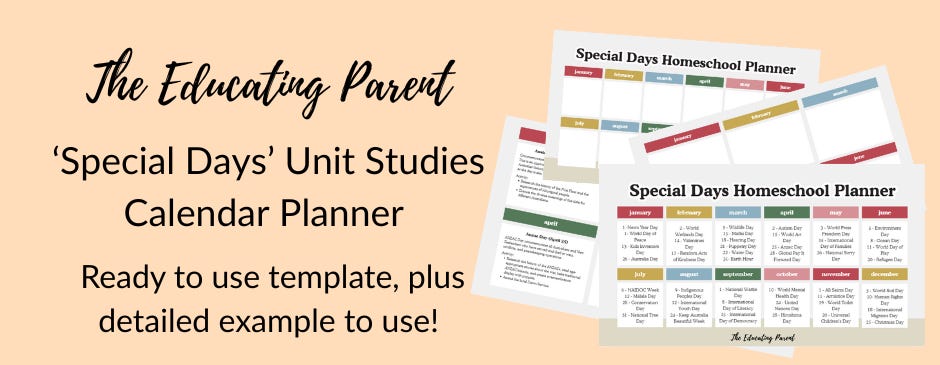
The next part of this newsletter is for paid subscribers, and includes a description of how you can plan your unit studies, together with a download to my special days calendar planner template. This 6 page template includes a 12 months at-a-glance planning page for overall coordination, plus a couple of pages on which you can sketch out a plan for each special day. I’ve also included a completed sample to demonstrate how to use the template, outlining suggested activities for selected dates, something you can put to immediate use.