

The Homeschool Spending Trap
Do you really need to buy that educational resource?

Do you feel that you need to buy everything just in case it’s needed someday? I used to.
How about feeling tempted when someone online raves about some new app, workbook or science kit? I do. I google it, finger paused on the buy now button.
Take it from me, someone that has spent too much time regretting past purchases, this is an aspect of home education you really need to think about and get a handle on, as soon as possible!
I’ve borrowed this set of excellent questions as a framework because coincidentally they are the same questions I asked over the years to help me take intentional control of my spending habits, albeit a little too slowly when it came to homeschooling resources and supplies.
The author, Joshua Becker, says “it’s easy to forget that our spending habits are shaped by our upbringing, advertising, social media, culture, and our friendship groups”, and that these voices subconsciously urge us to buy more.
One of my most enduring and important life lessons is learning to insert a ‘pause’ in all areas of my life. My mum used to say to me, “think before you speak or act”, and maybe this is what she meant. Make space for thinking. Pause.
Pausing before making a purchase, making time to consider one or more of the following questions, has saved me countless of dollars. And in doing so, I trained myself to make better spending decisions.
1. Do I really need this?
It sounds like a simple straightforward question, but until we’ve been homeschooling for a while and start to get a feel for how our children learn, as well as our own personal ‘teaching’ style, it is hard to know what is going to work.
Plus, with all the hype from curriculum providers advertising their products, and the incredibly dense and incomprehensible curriculum framework adding to the overwhelm and confusion, we’re frequently not at all sure what’s actually required.
For that reason, I recommend that we all write our own learning plans and set out how to do this in my free The Educating Parent Resource Directory or my inexpensive mini-course. Doing this will help you find your direction, and will guide you to the resources and materials that suit your learner’s needs.
Perhaps, the main value in asking this “do I really need this” fundamental question is that is gently eases us into learning to separate our needs from our wants. It guides us back to focussing on our children, and their needs, and our situations. rather than what the system wants, or what society is telling us we should want.
2. Do I own something else that can serve the same purpose?
It should go without saying that before buying something new, it pays to take inventory of what we already have that might fulfil the same purpose.
Our homes often contain perfectly good alternatives that we may have forgotten or overlooked. For example, I simply had to have a packet of maths counters I saw at the educational suppliers, forgetting that I had a set of unused poker chips in the games cupboard at home that would have worked just as well.
3. Am I buying this primarily because it’s on sale?
It takes a lot of willpower not to buy educational materials when they’re on sale!
At least half of the stationery I ever bought was never used, eventually sent to the op shop in as new condition. Not to mention the dozens of picture and reference books, picked up at a fraction of new price, which the kids never looked at.
It’s only a sale if you need it, and are going to use it. Otherwise it’s swapping money for clutter.
If you know you’ll be tempted, don’t look, don’t enter the shop or open the website.
4. Will I actually use it regularly?
Actually, before I ask this question, I drop the “regularly” and simply ask “will I actually use it”.
There are too many items I bought that just sat on the shelf, unopened. They looked good at the time: too good to leave in the shop. All too often I’d construct scenarios in my head of when and how we’d use them, justifying the purchase to myself, talking myself into buying it.
The question needs to be “will I use this now?”
And if the answer is no, think hard as to whether you’ll use it at all in the next few months. That’s where “will I use it regularly?” is necessary.
Because if you are only going to use it once or twice, consider an alternative such as borrowing from a friend, or making do with something similar that you might already have or could easily create from scratch.
5. What else could I do with this money?
This question is one I still use often. It really helps me pause and think, and help me weigh the pros and cons of spending.
Money is scarce. There are so many things we want to do, places to visit, performances to watch, exhibitions and more. Things we can’t normally afford. What am I giving up by making this purchase today?
Joshua reckons this is the most important question we should be asking ourselves, because our money can only be spent once, and once it’s gone it means it can’t be used for something more meaningful.
6. Will it add value to my life, or help me fulfil my purpose?
This one, when it comes to evaluating educational resources, is a bit tricky, because the answer is we really don’t know. But it’s worth asking anyway, because if the answer is a clear no, walk away, you’re wasting your time even looking at it.
And it does get you to think about your educational values and your goals, and what your child needs. It brings us back to the centre of why we’re doing what we’re doing as educating parents. And that’s something worth remembering.
7. How many hours of work does this purchase equate to?
Last week we ate out at a local restaurant. My meal didn’t cost a lot as it was a reasonably priced restaurant. But in one hour I spent twice as much eating this meal than it took to earn the money to pay for it. Which is why we don’t eat out much.
Converting the price of something into work hours is a sobering exercise.
I have to confess, this is one question I presented to the children more often than asked myself: “Do you know how many hours daddy has to work to be able to buy that LEGO set?” Hmmm.
And that thought makes me feel bad about all those unused educational resources that sat on the shelf unused for years. At least the LEGO was played with over and again!
8. Are there ongoing costs associated with this purchase?
This is a really important question. Quite often something looks like a good idea, but when we get it home we realise that it’s actually only a starter pack and not the whole thing. That happened to us more than once!
And then I remember taking one look at a copy of the The Bad Guys and knew that my grandson would like it. He did: I read it over and again until my throat was hoarse. Book 2, eagerly awaited for came out… and now there’s 20 in the series, plus two movies.
Which is actually a good thing, but we shouldn’t forget that series are developed this way as a deliberate ploy to hook us into buying more books.
I did try to borrow the rest from the library, but everyone else had the same idea, and they were never available when the kids wanted to read them. Sometimes the decision to buy is the right one, the one that works.
Subscriptions can be a hidden and too easily forgotten, money-guzzling trap too. If you’re clever you’ll set up a spreadsheet recording what you’ve subscribed to and set reminders for when payment is due. Many renew automatically, sending you an innocuous email that gets lost in the spam, robbing you of the chance to evaluate the ongoing purchase.
9. Am I buying this for myself, or am I influenced by someone else’s opinion or desire?
I’m going to take a guess here, but if you’re anything like me, most of the time I can honestly say my purchases are influenced by others’ opinions. That was, until I got into the habit of regularly asking myself this question. But even now I find myself clicking on a Facebook ad or reel, exploring a website, not because I sought it out but because the algorithm found me.
Media literacy is really helpful here. Our kids, in their teens years, would regularly watch Gruen, a program about advertising on ABC TV. We also subscribed to Choice magazine for a few years. Conversations about advertising and marketing were commonplace in our home. I had a habit of dissecting advertisements, talking about the tactics, such as emotional manipulation, marketers use.
Moneysmart, Mediasmarts and the Raising Children Network offer great information to help educate yourself and your children about the power of marketing.
Fads can be really problematic area for parents as much as it can our children. When KiwiCo launched it became super popular with Aussie homeschoolers despite the expense associated with shipping it from overseas. It became the done thing to offer our kids this amazing, quality resource. But within a couple of years you could pick up second-hand, unopened kits on homeschool buy, swell, swap groups.
That’s true for almost any new-beaut homeschool resource. And to be honest, how much has learning maths or phonics changed in 30 years? That unused student workbook you found in the thrift store may not look so pretty, but the content is probably not very different from something published last month.
10. Can this purchase wait?
That half-priced bargain begs to be bought now.
I know I probably won’t need, or use, it until my child is ready, and that we’re not covering that subject or topic until later in the year. And I know that if I wait, I might have to pay full price for those materials. That’s the hook. The fear-of-missing-out marketing ploy.
Chances are if we wait, we’ll come up with another way of sourcing that resource when needed. It might mean borrowing a telescope or organising a group session through the local amateur astronomy club instead of buying one today.
11. What is my emotional state?
When younger I relied on coffee to get me through the day, not realising that for me, caffeine is a powerful stimulant, elevating my mood and making all things seem possible. These days were usually followed by low mood days. On those days I never went shopping, but oh boy, on the coffee days, money would slip through my fingers!
I have to agree with Joshua on this: “Shopping under emotional influence (stressed, bored, sad, lonely, angry, or even overly excited) often leads to regretted purchases.” I have certainly lived to regret some of my (usually expensive) educational purchases.
If you’re not sure about how you’re feeling today, hit that pause button. Wait a day or so. See if you still feel like the purchase is a valid one, and needed.
12. Is this an impulse buy?
And this leads us neatly to the issue of impulse buying.
The internet is an impulse buying trap. But then again, so are shopping malls. They’re both designed to be that way.
We homeschoolers can spend a lot of time browsing or window shopping.
If you don’t need something don’t do it, stay away. Go wash the dishes, play a board game with your children, or take the dog for a walk.
If you didn’t plan to buy something, and haven’t considered it previously, run through the pros and cons, pause. Ask yourself this set of questions over and again: Do I need it? Will I use it regularly? Can it wait? How many hours of work is needed to cover it’s cost? Is it worth it?
Sometimes, just adding that thinking pause is enough to dispel the impulse urge.
13. What will happen if I don’t buy this?
I rarely get to ask this question as I’ve already made up my mind to buy the item or move on. But occasionally I have stood there and thought, “if I don’t buy it, what will happen?” and the answer is usually “nothing”.
Sometimes the answer will be an idea for different ways I can achieve the goal that prompted considering the purchase. And often this is usually because the above questions have got my lateral thinking skills sparking.
I find that Google is my friend and I can usually find free lesson plans and activities, apps and other useful resources online when and if we need them. I am astounded at the range and scope of learning materials and information available on the world wide web. And my grandkids seem capable and able to find them much quicker than I can.
It can be tempting to bookmark a gazillion sites, but I’ve learned that we only need a few good quality ones to cover most of the things I want to put in front of the kids and grandkids.
“Cannot people realize how large an income is thrift?” Marcus Tullius Cicero
My The Educating Resource Directory is packed full of pages of listings to educational suppliers and providers wanting to sell to homeschooling families. And that’s mainly for an Australian market, with around about 50,000 homeschooling students. I can only imagine the size of the homeschooling market in the UK and USA.
People want — and need — our money.
As a content creator for the homeschool market, one that earns my daughter a little bit of cash which she promptly spends on my grandkids, I’m motivated to market to you, and convince you to buy our homeschool learning plans, my mini-course, or e-books. But my aim, in creating those products, is to help you become a DIY, do-it-yourself homeschooler, to help you create and follow your own curriculum, so that you can tailor your purchase decisions to meet your child’s learning needs in this moment
Buying from a small homeschooling business makes sense for lots of reasons. But even then, I encourage you to pause and work your way through the above set of questions.
Homeschooling doesn’t have to cost us an arm and a leg. When all is said and done we really don’t need half of the resources marketed to us — actually most of them.
What our kids need more than fancy lesson plans, gadgets, educational toys and apps, is our time, our energy, and our love.
As I paused to proofread and edit this post Gaia Pampu’s I think the estimates of what it costs to homeschool are off… by, like, a lot landed on my desktop — well worth a read. It also referenced Lynda Apostal’s The Myth of Education by Consumption, another good read.
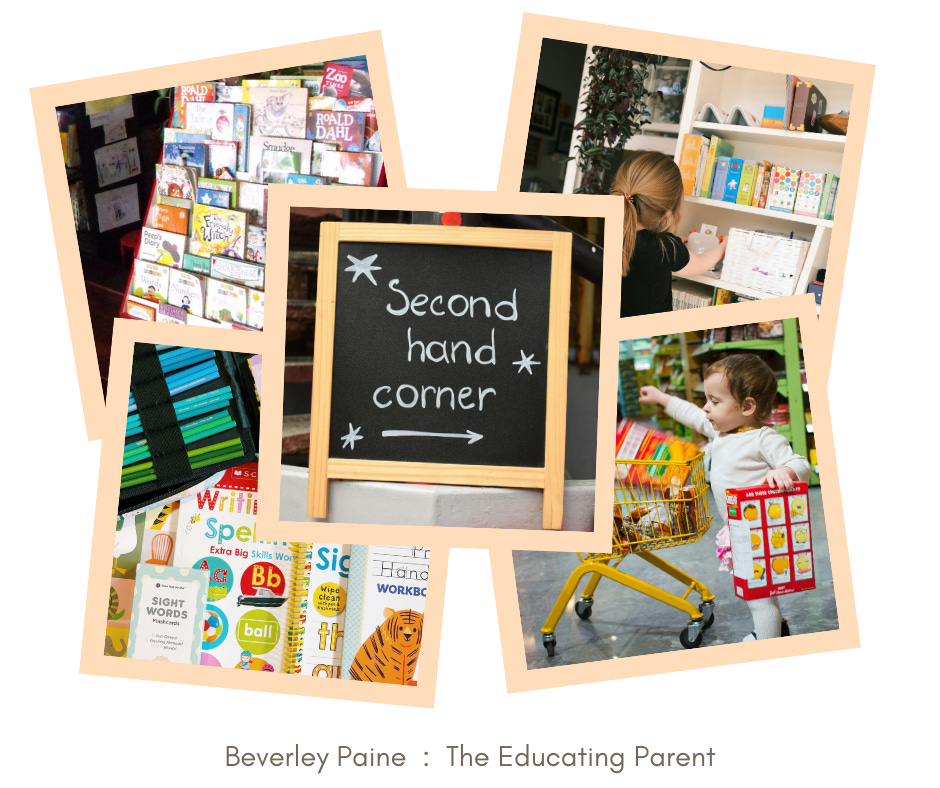
I’m dropping Notes most days and would love to connect with you that way — you can add a comment or like. Don’t forget we can keep the conversation going on any of my posts by adding a comment there too.
If you’re homeschooling in Australia, don’t forget to download my FREE Resource Directory for a bumper list of educational and curriculum providers and suppliers, as well as comprehensive guide on getting started how to register as a home educating family.
Whatever your approach, your lifestyle or education philosophy, I’m here to support you. Take what you need, leave the rest. I want you to lean on my experience because I’ve leant on others — we are in this together, growing and learning from each other!
To my paid subscribers, who receive my exclusive Monthly Free Resources Round Up Newsletter, plus the occasional free homeschool templates, checklists, unit studies, infographics, e-books and more, I can’t thank you enough for supporting my work!
That’s all for now! Until next time, Beverley

Such an important aspect of home educating, and parenting in general. It’s so easy to fall into the trap of buying excessively when we convince ourselves it’s “for the children”.
I think the most relevant questions for me on this list are
- Do I own something else that can serve the same purpose?
- What else could I do with this money?
- Am I buying this primarily because it’s on sale?
That last one in particular has caught me out many times before but I’m getting better at not “swapping money for clutter”!
One thing I found helpful as a stepping stone to buying less, is browsing Amazon and putting things in my shopping cart or adding them to a wish list but not making the purchase. I get a small dopamine hit from adding things to my cart or list, enough to satisfy the craving to buy, then I leave it. When I return days later I usually empty the cart or move them to a list, where tbh and I never think about them again. But knowing they’re there in case one day I might need the feels reassuring. Better on the wishlist “just in case” than in the house!
Of course, this is not a full solution, because I still wasted time browsing, but I’m working on that! And I’ll take the win that I’m not wasting both money AND time.
This is so well written - as per usual! I so appreciate the shout-out to my most recent post. Thank you!! We're only halfway through our first year of homeschooling, and there is still so much to unlearn, especially when it comes to spending and the assumption that the more we spend, the higher quality education we're delivering to our daughter. A loaded assumption with all kinds of negative ripple effects further down the line...
Hitting pause before buying is something I'm actively trying to practice.
And yes, yes, YES, the goal is to become a DIY creator.
I do believe homeschooling shouldn't cost an arm and a leg. I also believe we can do a lot by being transparent about our mistakes and our lessons learned - which you capture perfectly here.
Preach it <3