

Stop Comparing: Why Your Child’s Learning Journey Is The Only One That Matters
What standards guide you as an educating parent?

Over the next few months I will be sharing posts from my archives, written while I was still home educating my kids, mostly during their teens, reflecting over the previous decade. This one is from 1999 and first published on my website. This is a reader supported blog, if you like what you read and find it helpful, please share with a friend
Most of us compare our children to other children, both homeschooled and schooled. But even more than that we compare them to the imperfect memory of our own schooling or education and set our standards for our children’s performances accordingly.
I set high standards in English for my children, mainly because I love to write, and was very good at English at school. I sometimes wonder about how old I was when all that started. Without records it is hard for me to really know how good my work was... I remember my mum confiding later in life that she was worried my first grade teacher would tell I was retarded, because I was generally non-verbal at home, and hadn’t shown any sign of being able to read and write (this despite one of my favourite places being the local community library!) Suffice to say, reading and writing are a huge a part of my life, something I value highly.
As a result, when I started homeschooling I tended to compare what my kids’ work and what they could do to what I remembered of my own ability at the same age as a school kid. But worse than that, I was in a bit of a hurry to elevate them to the standard I’d achieved as an adult. This impatience meant I inadvertently kept jumping steps, which natural led to backtracking. It took me more than a year or two to stop doing this, and when my children started homeschooling at high school level the tendency reared its head again and went into hyperdrive!
It’s too easy to fall into the trap of trying to replicate the kind of education we experienced in school ourselves, especially if we considered that relatively successful. And I’ve met families that do this even if their own school experience failed them miserably. Why? Because for many of us, this is our only experience of education. It’s why we tend to start home education as ‘school-at-home’.
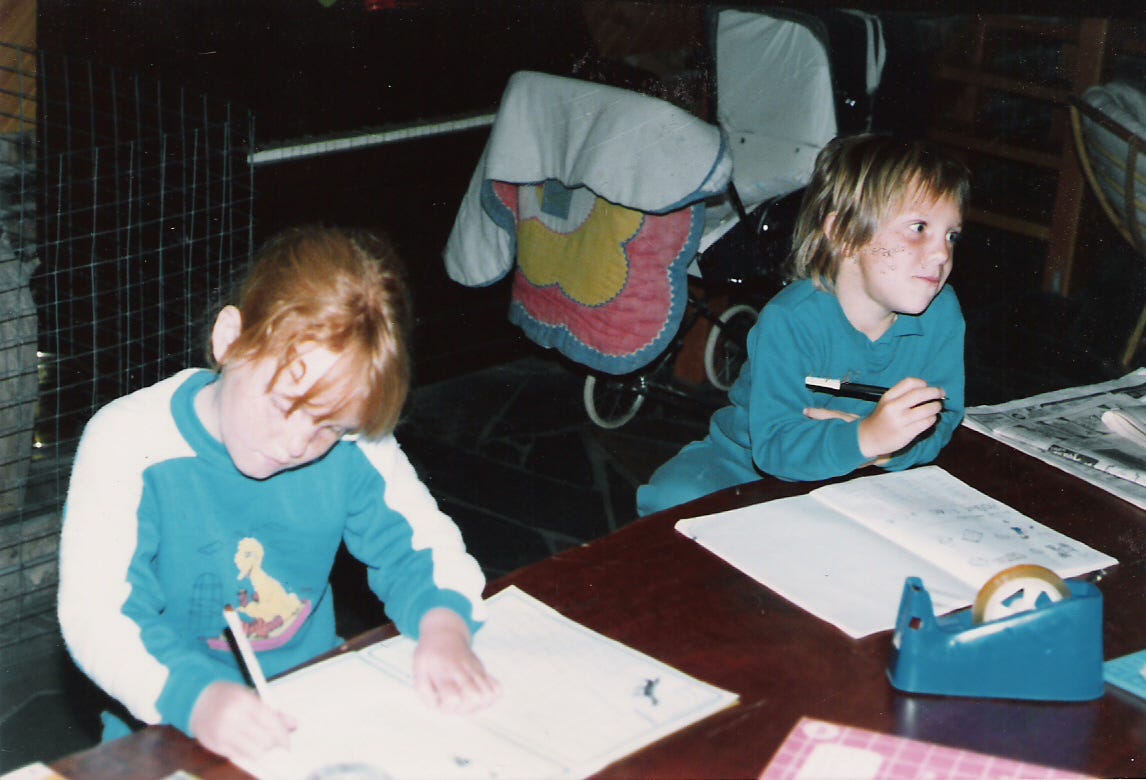
The problem with this way is that it fails to reflect a vast amount of research in learning theory and good educational practice. Teachers would love to be able to deliver learning programs tailored to individual children’s needs but are constrained by a lack of funding and resources.
There’s a quote that stuck in my head that says education is lighting a fire rather than filling a bucket. I know I’d rather be sparking away... and my kids too!
“Education is the lighting of a fire, not the filling of a pail.”
attributed to William Butler Yates, but probably actually Plutarch
Not replicating my own narrow experiences of education and expanding my knowledge and experiences are ways I can achieve this.
I read as much as I can on the subject of education, including material written by teachers and researchers, not just books about home education. It all helps me build a better picture of how learning actually happens (and there’s a lot we don’t know, but science and technology are allowing us to probe this in ways that are simply amazing.)
When reading I ask myself if what I am expecting of my children is developmentally appropriate, given their individual learning needs and styles and personal temperaments, and try to separate my memories of myself as a learner at that age out of their learning processes! Just because something worked for me, or their dad, doesn’t mean it will work for them.
I find that parents often aren’t sure where their children are at, and they worry if what they are doing and learning is ‘typical’ for their age. Concern about unknown educational or developmental problems, or ‘falling behind’ undermine their confidence as educating parents.
There are a couple of things I do to help me overcome these moments of worry. The first is quite simple: I get back into the habit of record keeping, jotting observational notes of everything my children do over a few weeks. This record allows me to quickly check progress and ability, including against curriculum standards or developmental checklists.
I never find it useful to compare my kids’ development against other kids’. I try to remember that we’re all different, with different situations and circumstances, personalities and needs. And that the whole point of home education is to be able to provide an individually tailored educational experience.
Another trick I employ regularly is to spend a few moments thinking about what would happen if my kids went to school tomorrow. Would things be any different? Would they be learning the right things for them at the right age? No!
Would all the kids that age, or in that class, be at the same level, be able to do the same stuff, to the same standard? Definitely not!
If my sons were ‘behind’ would they be helped to ‘catch up’? Once again, the answer is no, not really.
And if they were ‘ahead’ would they be given ‘extension work’ suitable to their individual learning needs. I don’t think so. Very unlikely.
Having carefully considered this alternative to home education, I’d always feel better about whatever I was dishing up for kids every day. Even if it wasn’t a superior education, or high quality every moment of everyday. That’s just being unrealistic.
And I’d come to the conclusion, yet again, that it’s better to be stuffing up my children’s education than letting some stranger do that!
At least this way, whatever terrible mess I make today I can set my mind to fixing tomorrow. I’m answerable to my kids in the here and now, and too often that doesn’t happen in the school classroom. Sadly too many schooled kids do get left behind.
I’ve often heard educationalists and parents making much ado about helping their children reach their ‘full potential’. I wonder what this really means and if it is at all possible? If it is a sensible goal? I ask myself if I have reached my potential? Could I do better in life?
My father continuously thinks so and tells me! To him I am unsuccessful, a hippy dropout, someone who chose not to make something of her life and instead became a stay-at-home mother.
Is this how I want to judge my children later in life? His words often hurt, but then I think about it carefully. What is the best that I can do? Who should be the judge of that? You, my father, that teacher over there, the stranger in the street, or me?
The answer came to me somewhere in my 38th year of life... Me.
I allow my children to grow in the knowledge that they have responsibility over their own education, and that they have a real say in what and how they learn. I expect them to tell me if I am falling short in my role as educational facilitator. They know this. I will listen to them, sometimes not willingly or happily, but their input is vital.
I supplement that by tuning in as attentively as I can, anticipating their needs, finding resources and methods that will work with them, and help them learn.
Setting goals that are realistic for our children (to meet their individual need, rather than an arbitrary standard) is important, and something we so often overlook. More often than not when confronted with a goal that wasn’t being achieved in our homeschooling life, reflecting on why usually led me to the conclusion that the goal wasn’t actually an appropriate one for this child at this point in time.
For example, when my youngest started writing his name and other ‘words’ using upper case letters at age four I started teaching him how to write lower case letters because everyone else learned lower case letters first. I totally confused the poor kid and he became a reluctant writer from that point on. I wished I just let him be and find his own way. Not all kids would react this way: the point is, mine did. Home education lets us work with the child in front of us.
Instead of comparing my kids or myself to others, I like to think about what are able to do based on what we’ve done and learned in the past, and ask myself if the objective is reasonable for them or me, at this point in time, in this set of circumstances.
I was a bit slow to learn and accept fluctuating capacity, but it definitely affected our lives. Some days we’re not up to par and can’t perform at our ‘personal best’, so expecting all the time is definitely unreasonable.
And when we couldn’t do or learn things we, ourselves, expected to learn, we became sleuths, searching for the reasons why. Perhaps we were tired, or unwell. Perhaps something had upset us earlier and we were still processing those emotions.
Plus, I don’t see the need to measure up to anyone else’s standards: even though my standards might be suspect that were based on my values, and I’m prepared to rationally defend my values even if they are different from other people’s, or some that are generally prevalent in our society. I hope my children will be able to do the same when they are adults.
I try not to measure my children up against some arbitrary, or averaged, standard. Comparison is a tricky trap to fall into and I know that I still sometimes end up doing that, but make a point of noticing when, and then working out why, and then adjusting my behaviour accordingly.
One of the interesting things I have noticed is that all three of my children will do absolutely mediocre work most of the time, but when motivated by personal interest or desire, they usually achieve a level of excellence that has been described by others as gifted. It doesn’t happen often, and always on their own terms.
I’ve also noticed that they tend to learn much faster and with less difficulty, or practice, as they get older. I remember in our early years believing that it is important to teach children when they are young, get them learning as early as possible, as it is supposed to get harder to learn as we age. This wasn’t our experience. And our kids view themselves a life long learners.
On the whole, home educated children aren’t dissimilar from their schooled peers. They will advance in skills and knowledge and understanding at a pace that matches their learning styles and needs, if someone is there to help them, provide them with support and appropriate resources.
Home educated kids are just learning in a different way, usually the same things, but in a different order to their schooled peers. It doesn’t help, and can be a nonsense to compare them to schooled kids, or to other homeschooled kids.
It’s okay to go with your gut and be guided by your own values when determining if what and how your child is learning and progressing is okay. Trust in yourself. Be open to what others’ think, keep reading and learning. You’ll grow and change too, and you may challenge your values or they may deepen depending on your experience. That’s natural.

I drop notes most days and would love to connect with you that way: add a comment or heart to let me know what you think. Don’t forget we can keep the conversation going on any of my posts by adding a comment on them too.
That’s all for now, happy homeschooling and unschooling!
Beverley

Here’s what you can expect from my regular newsletter:
Themed Weekly Focus: Each week has a clear focus, helping you strengthen key areas of your homeschool without feeling scattered.
Encouragement for the Hard Days: Because we all have them, and sometimes a fresh perspective is all we need.
Practical Tools & Ideas: Information about homeschool resources, hands-on activities, exclusive templates, and ways to simplify planning.
Real Talk About Homeschooling: Honest discussions about the challenges and triumphs from someone who has been there and done that, and whose kids are now homeschooling theirs!
So much gold in this! Thank you.