

I hate maths!
how to fix math phobia as a homeschooling parent

Confession time… I actually liked maths! But by the time I got to year 11, maths didn’t like me. But I didn’t care, even though I had no idea what I was doing, maths was still cool and awesome. At this point, if you haven’t already realised it, I am a self-confessed weirdo!
Not many people like maths. And I think that’s sad, but understandable.
Sometimes I’ll field questions by parents who want to homeschool but don’t think they can because they don’t think can because they’re not good at maths.
And it’s a rare thing to come across a homeschooling parent who actually feels confident — or competent — in maths enough to help their kids master it.
Math phobia can get in the way. We can easily pass it on. Which we don’t want to do… So how can we fix this?
The first thing is don’t tell your kids that you hate maths. Even if you did when you were at school. Now that you’re an adult it’s time to have that conversation with yourself — do you really hate maths, or do you just feel incredibly incompetent? And then ponder awhile about why you feel that way, why is maths such a mystery to you, why is it hard, unfathomable? Could it be because you weren’t taught in a way that suited your learning styles and needs?
You aren’t the teacher you had as a kid. Time has moved on: resources and methods have changed since then. Online education offers kids and adults a variety of different ways to learn. If you don’t know how to work something out, ask Siri or Alexa, or ChatGPT. Google it. Look it up, watch a YouTube video or three. Don’t like that method or presentation? Find another one. There’s oodles online…
Go back to basics, grab some gummy bears as counters. Build, make and create in any medium using rulers and protractors. Play with blocks. Build and fill 3D shapes. Play shops, or board games. Practice mental arithmetic when scoring in dice and card games.
Integrate maths learning in everyday activities. Talk about what you’re doing and learning using mathematical terminology. The sun is a sphere. The volume of this kettle is 2 litres, but I’m only putting in enough for the two of us, so that’s 2 cups or 500 millilitres. I’m cutting out half-square isosceles triangles to sew into a quilt. Let’s measure how high you are today using centimetres and your ruler. If you don’t know what word to use, look it up.
Secondly, it’s time to stop that negative self-talk. Just because someone else graded you down, or didn’t think you were mathematically capable, doesn’t mean you don’t have some math ability. You do!
Identify and talk up your maths skills, the ones you naturally use everyday. Celebrate the areas of expertise you do have.
You may not be a whiz at calculus, but you can put together a balanced budget each week, making sure you have enough money to pay for that trip to the zoo. And you can find your way home no matter where you are; or maybe you can't, but you do know how to use a map. And you know instantly if you’ve short changed at the checkout, because you’ve been roughly adding up as you add items to your shopping trolley.
You can knit, crochet or sew. Fix the car or build a fence. Or create LEGO models or Minecraft castles. Accurately gauge your stopping distance when driving. Estimate weights accurately when you are buying fruit. You can compare prices, work out discounts.
These are all mathematical related activities. You think and operate mathematically. You ARE a mathematical being!
And you can learn, alongside your children, anything you need to learn, at any time. You are a wonderful, capable learner!
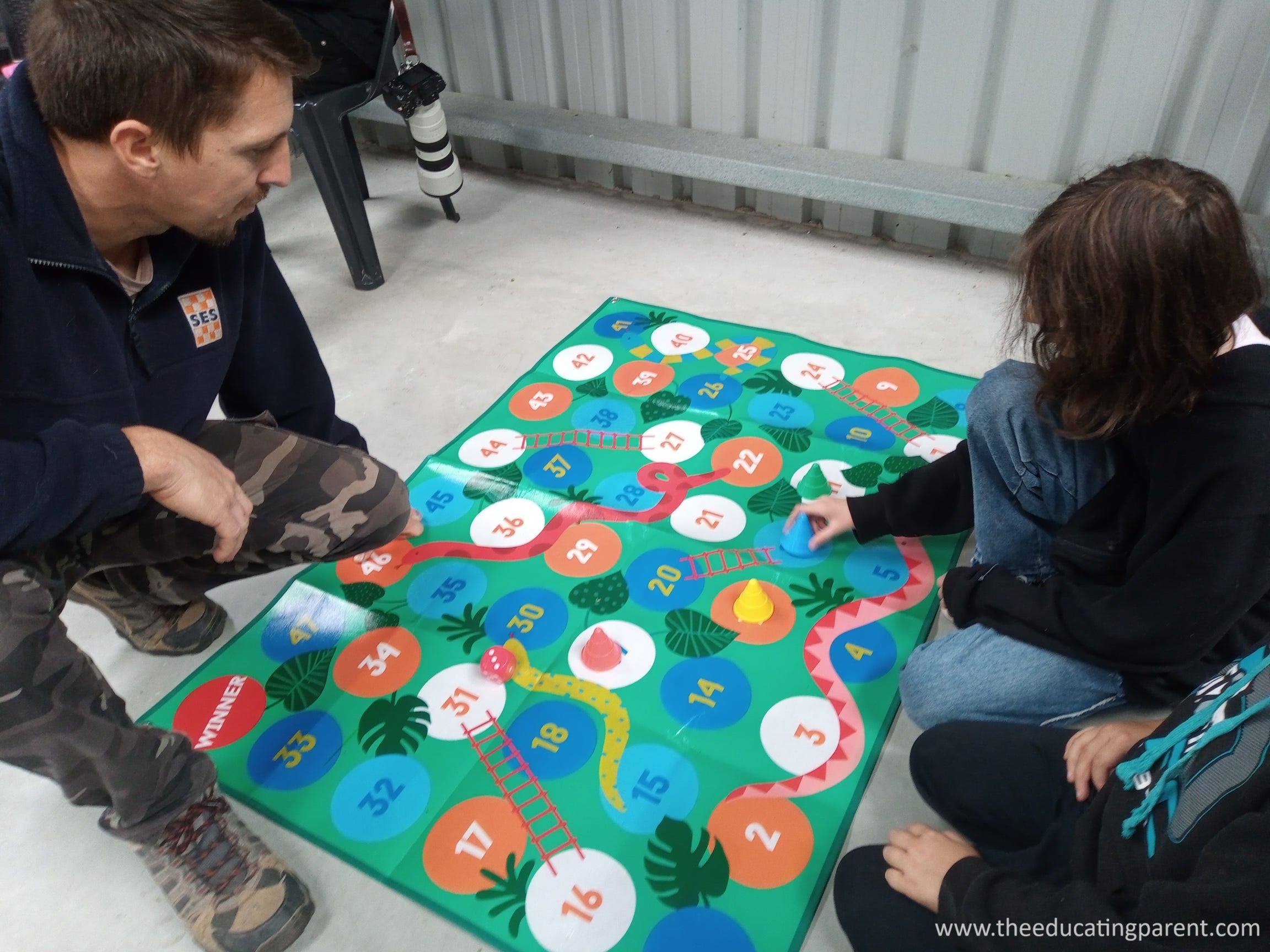
photo by author of her son playing Snakes and Ladders with his children